Angular localization
for i18n and ngx-translate
Manage XLIFF and JSON translation files, auto-translate with AI, and sync with your Angular app via CLI.
We power your product localization
From first commit to global launch














Why Angular teams
use SimpleLocalize
Angular localization can start with one source language, then quickly grow to many locales. Teams using Angular i18n or ngx-translate often manage many files across modules and branches. Manual file edits lead to missing messages, invalid placeholders, and merge conflicts.
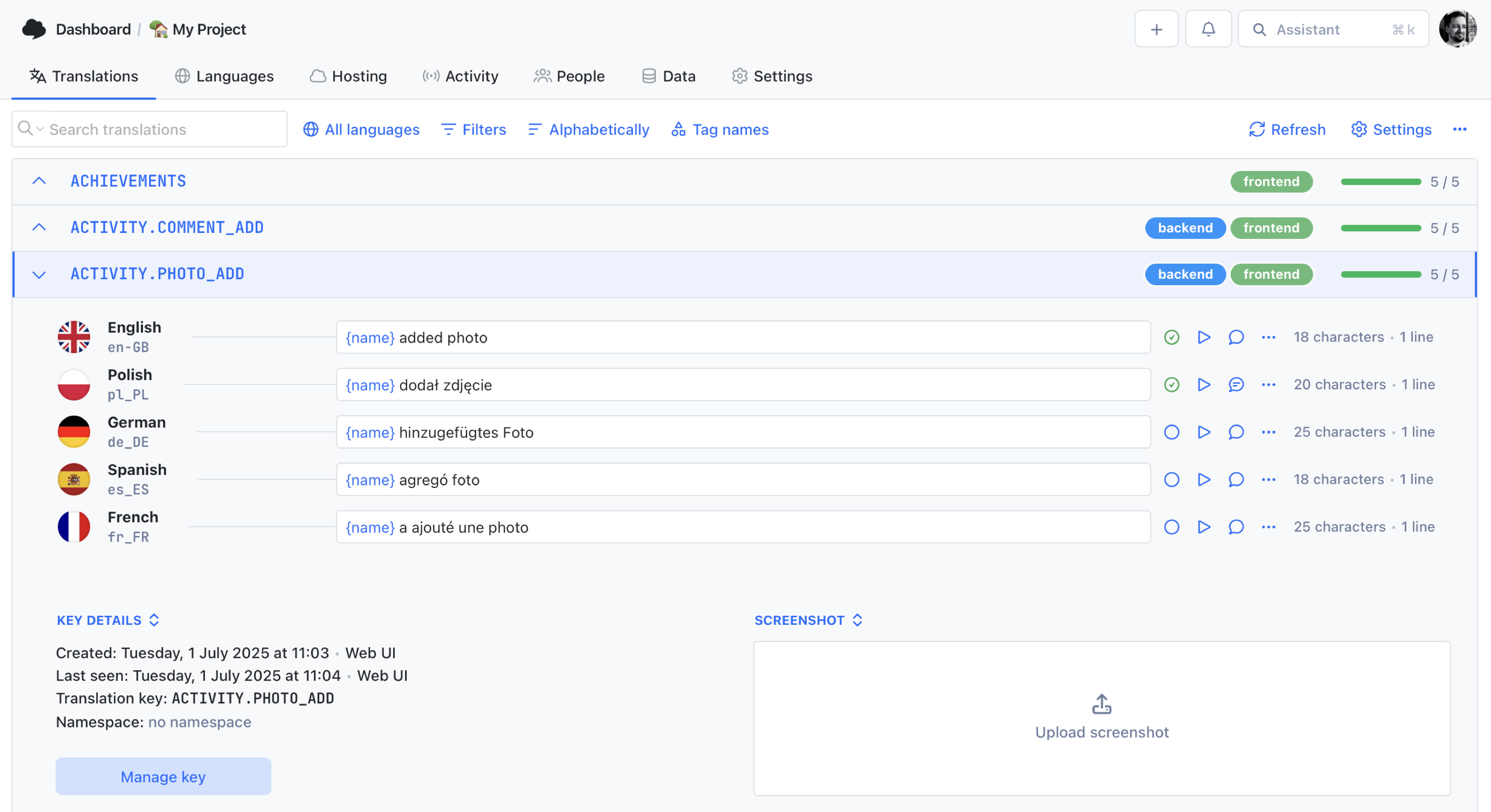
SimpleLocalize gives your team a single source of truth for translations. Upload XLIFF or JSON via CLI, translate in the online editor, and download files ready for Angular builds.

Built for the Angular localization workflow
From source messages to production deployment, SimpleLocalize fits each step of your Angular i18n setup.
How it works
From Angular source files to production in 3 steps
A CLI-first workflow that keeps Angular translations updated with every release.
Upload source files
Run simplelocalize upload to push your source XLIFF or JSON files. Message structure stays intact.
Translate and review
Auto-translate with DeepL or OpenAI, then review in the online editor with your team.
Download and build
Run simplelocalize download to pull translated files. Build and deploy with current translations.
For a step-by-step walkthrough, see the getting started guide.
Ready to simplify Angular localization?
Start a free project and upload your first translation file in minutes.
Start for freeCLI pipeline
From source files to production
in two commands
Upload source files, translate in the cloud, and pull clean files back into your Angular project.
Add these commands to CI/CD for automated localization in each build. Read more about the i18n online editor and visit all developer tools.
One project
for Angular, Vue, and React
Building multiple frontends? Manage all translations in one SimpleLocalize project and export each framework format separately.
Angular (XLIFF/JSON)
Manage Angular i18n and ngx-translate resources in one place.
Vue (JSON/YAML)
Manage locale files for vue-i18n and keep keys consistent across Vue apps.
React (JSON)
Export JSON files for react-i18next, FormatJS, and other React i18n libraries.
Why SimpleLocalize
Built for Angular developers
Practical tooling that matches Angular localization workflows.
Start localizing your Angular app today
- All-in-one localization platform
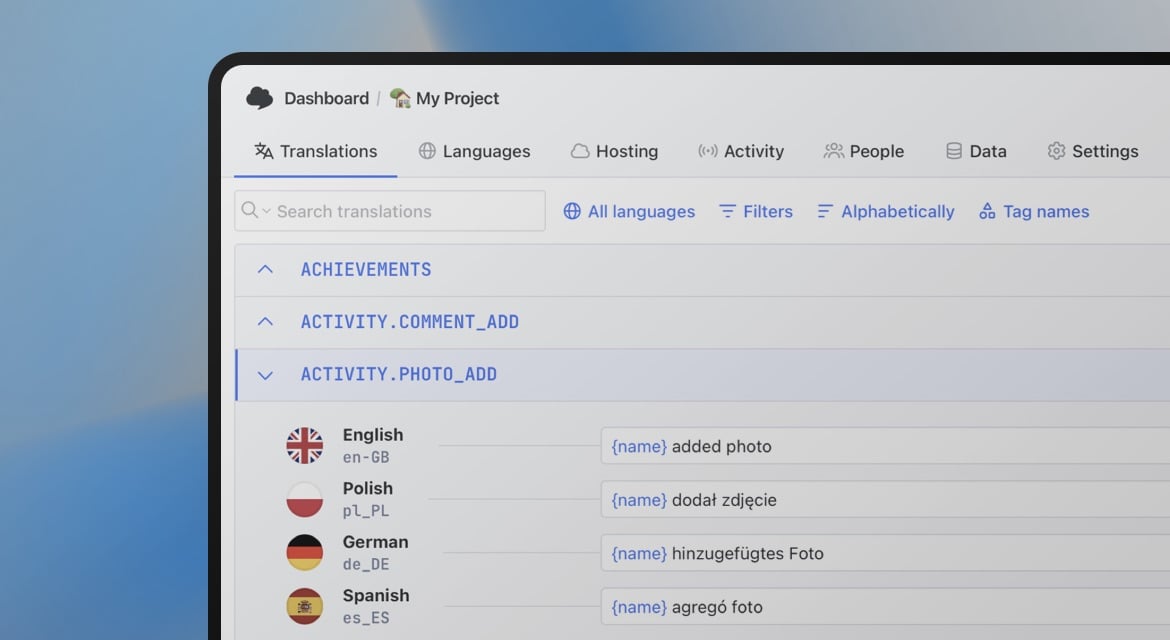
- Web-based translation editor for your team
- Auto-translation, QA-checks, AI and more
- See how easily you can start localizing your product.
- Powerful API, hosting, integrations and developer tools
- Unmatched customer support
"The product
and support
are fantastic."
"The support is
blazing fast,
thank you Jakub!"
"Interface that
makes any dev
feel at home!"
"Excellent app,
saves my time
and money"
Angular localization resources
Guides and tutorials for Angular localization with SimpleLocalize.
Android String resources: Complete guide to localizing Android apps
Learn how to manage Android string resources, plurals, and arrays. A technical guide to localizing Android XML files with SimpleLocalize for seamless translation workflows.
Vue.js i18n: The complete guide to localizing Vue and Nuxt apps
Learn how to internationalize and localize Vue 3 and Nuxt apps with vue-i18n. Covers setup, translation files, pluralization, locale detection, lazy loading, CI/CD integration, and SimpleLocalize workflows.
Xcode String Catalog (.xcstrings): The complete guide for iOS localization
Everything developers need to know about .xcstrings string catalogs. Covers JSON schema, extractionState and translationState flags, pluralization, device variants, universal placeholders, Git merge conflict strategies, Xcode 26 AI comments, and SimpleLocalize integration.
Python and Django i18n: A practical guide for developers
How Django's built-in i18n system works: gettext, message files, plurals, locale URLs, and syncing translations with a TMS.
API-Driven localization: Designing scalable translation infrastructure
How API-driven localization works: architecture patterns, caching, rate limits, and when to use an API instead of CDN hosting.
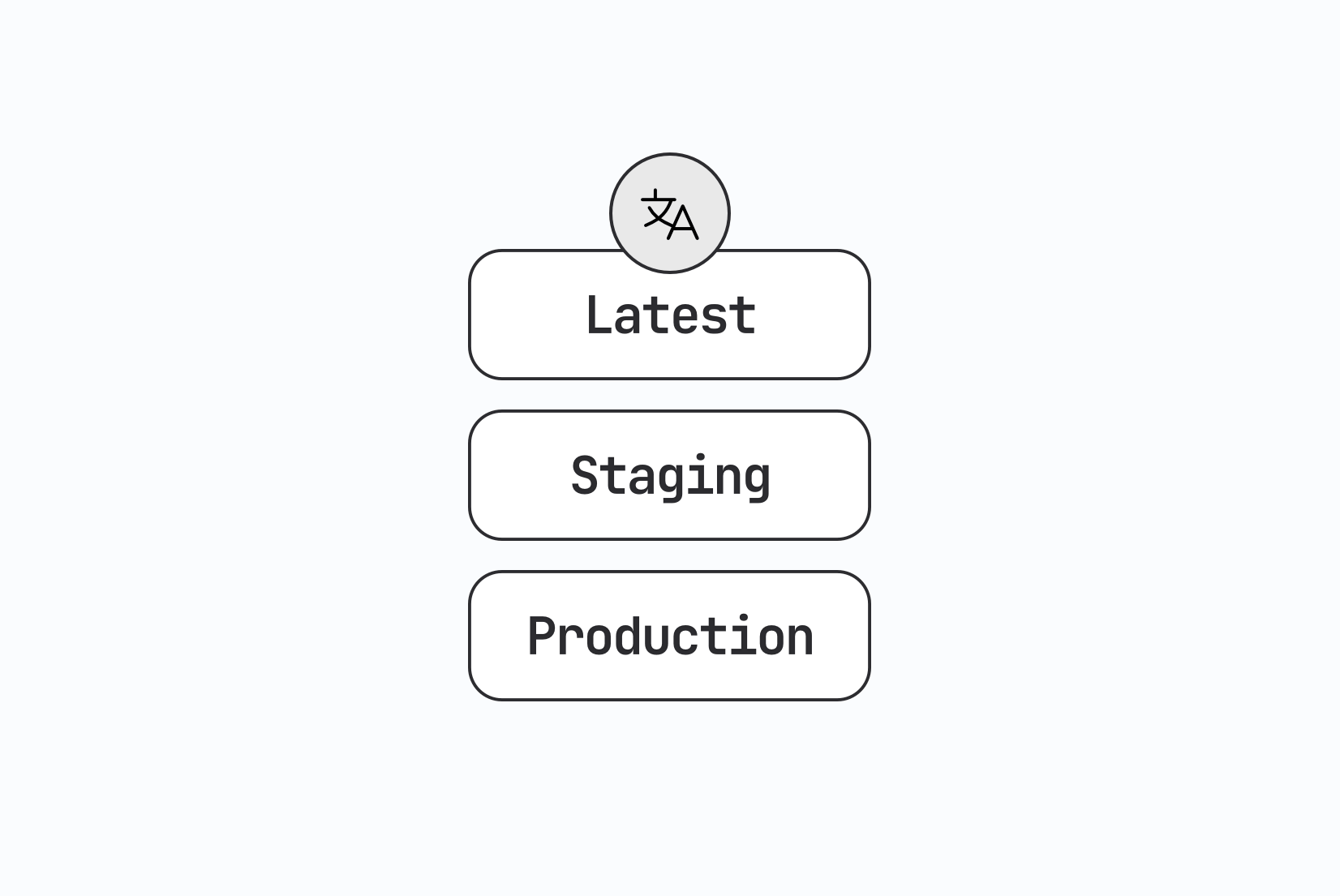
Environment-based localization: Managing translations across dev, staging, and production
Learn how to manage translations differently across dev, staging, and production. Environment setup, missing key behavior, CI/CD promotion, and real workflow examples with SimpleLocalize.
Frequently asked questions
How does SimpleLocalize handle Angular translation files?
SimpleLocalize supports Angular i18n files in XLIFF and ngx-translate files in JSON. Upload source files through CLI or API, manage translations in the online editor, and download files in the same format.
Does this work with Angular i18n and ngx-translate?
Yes. You can use the same SimpleLocalize project for Angular i18n and ngx-translate setups. The workflow is the same: upload source files, translate, then download files for the app.
Can I manage ICU messages and plural forms?
Yes. SimpleLocalize supports ICU message syntax and validates placeholders and plural forms across languages to help catch localization issues before deployment.
How does this fit into Angular CI/CD pipelines?
Add simplelocalize upload and simplelocalize download commands to your pipeline. Source messages are pushed and translated files are pulled automatically in each build process.
Can I manage Angular and other frameworks in one project?
Yes. One SimpleLocalize project can include Angular, Vue, React, mobile, and backend translations with one shared key base and multiple export formats.