AI vs MT: Auto-translation comparison with examples


Auto-translation services have become essential tools for breaking down language barriers in today's world. While traditional Neural Machine Translation (NMT) engines like DeepL and Google Translate remain industry staples, Large Language Models (LLMs) have completely shifted the localization landscape.
SimpleLocalize supports traditional machine translation alongside an expansive array of advanced LLMs and custom AI providers via OpenRouter integration. In this updated post, we will move past theoretical arguments and analyze exactly how traditional machine translation engines compare directly against top AI models like GPT-4, Claude 4.5 Sonnet, Gemini 2.5 Flash, and Llama 3.3 (70B) using real, production-ready raw JSON output.
If you want the broader framework behind these provider choices, start with our complete AI and machine translation guide.
If you already know the providers and need a faster routing decision by content type, see AI translation for software teams: MT engines vs. LLMs vs. local models.
Traditional Machine Translation vs. AI Localization
Traditional Machine Translation (MT/NMT) uses neural networks to swap words based on sentence structures. It is blazing fast and highly accurate for straightforward prose, but it translates strings in complete isolation.
AI-powered Localization (LLMs) treats translation as an instruction-following task. Because modern LLMs understand context, developer syntax, and formatting frameworks like ICU expressions, they don't just substitute words—they adapt the content while preserving code safety.
Common issues with traditional machine translation
While traditional NMT has come a long way, it frequently struggles with software-specific data structures:
- Variable corruption: Blindly translating or altering variable placeholders like
{username}or%s. - ICU MessageFormat failure: Breaking plural or select syntaxes by translating logic keywords (like
plural,one, orother). - Context blindness: Translating a interface button labeled "Close" as an adjective instead of a verb.
- Tone mismatch: Failing to maintain a casual or formal brand voice across a full application framework.
The Auto-translation test suite
To see how these engines stack up, we fed them a realistic application JSON bundle containing short context-dependent UI labels, HTML tags, brand-specific nouns, and complex ICU MessageFormat plurals.
Here is our English source dataset:
{
  "landing.hero.title": "Your home away from home",
  "landing.hero.subtitle": "Book a room in seconds. No surprises at check-in.",
  "booking.action.submit": "Book now",
  "booking.status.available_count": "{count, plural, =0 {No rooms available tonight} one {Only 1 room left!} other {We have # rooms available}}",
  "hotel.amenities.room_service": "Room service",
  "hotel.amenities.executive_lounge": "Executive lounge",
  "hotel.policy.pillow_menu_info": "Browse our Pillow Menu and choose the best one for your restful night at Pillow Hotel.",
  "hotel.policy.late_checkout": "Late check-out",
  "checkout.alert.cancellation_policy": "Please review our <strong>cancellation policy</strong> before confirming your booking.",
  "checkout.dialog.close_button": "Close",
  "checkout.security.brand_guarantee": "Your booking is protected by PillowSafe guarantee.",
  "checkout.terms.confirmation_dialog": "Clicking \"Accept\" means you agree to the terms."
}
Let's dissect exactly how six different translation frameworks processed this file into Spanish and Polish.
Detailed model breakdown & results
DeepL
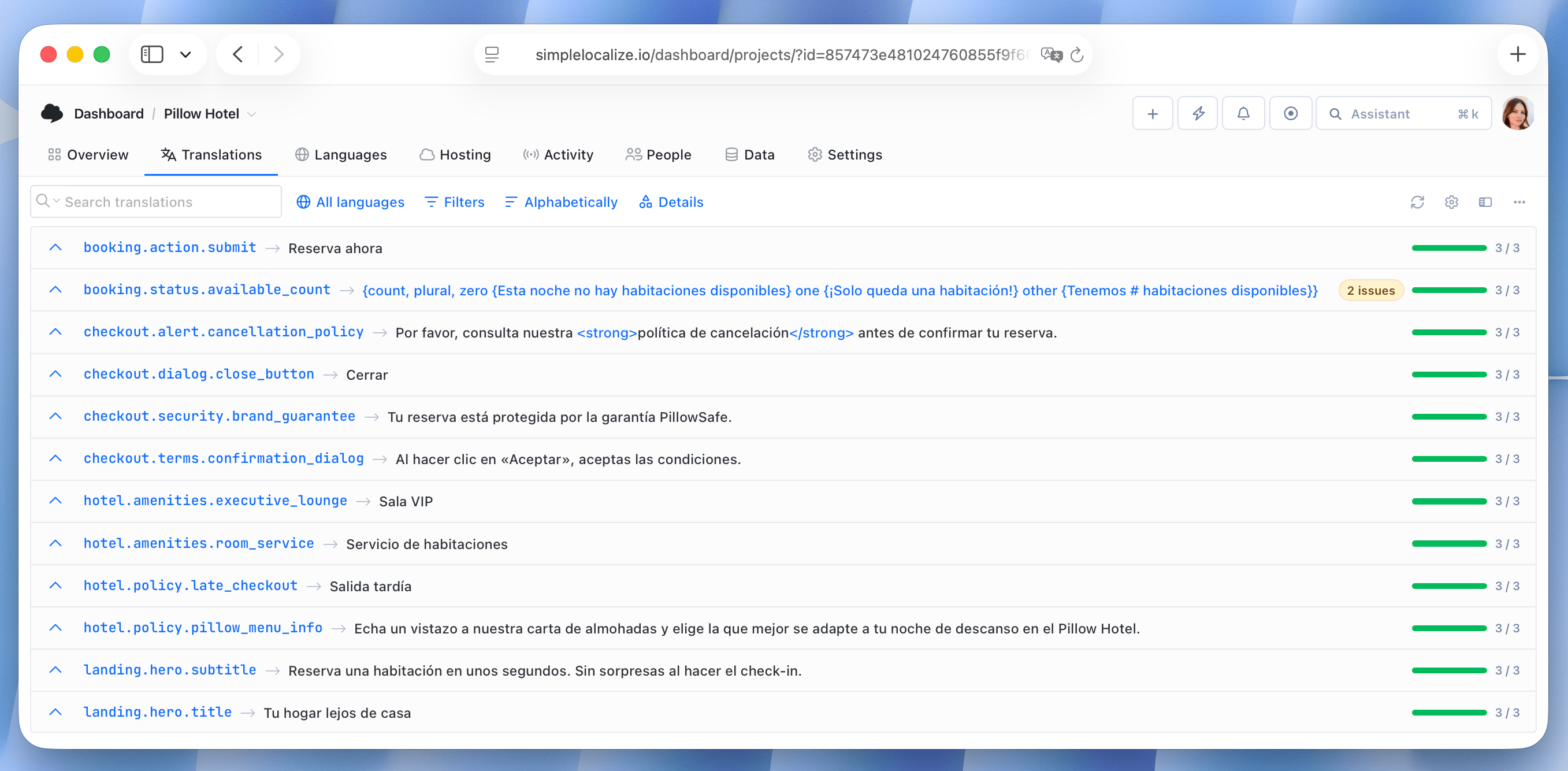
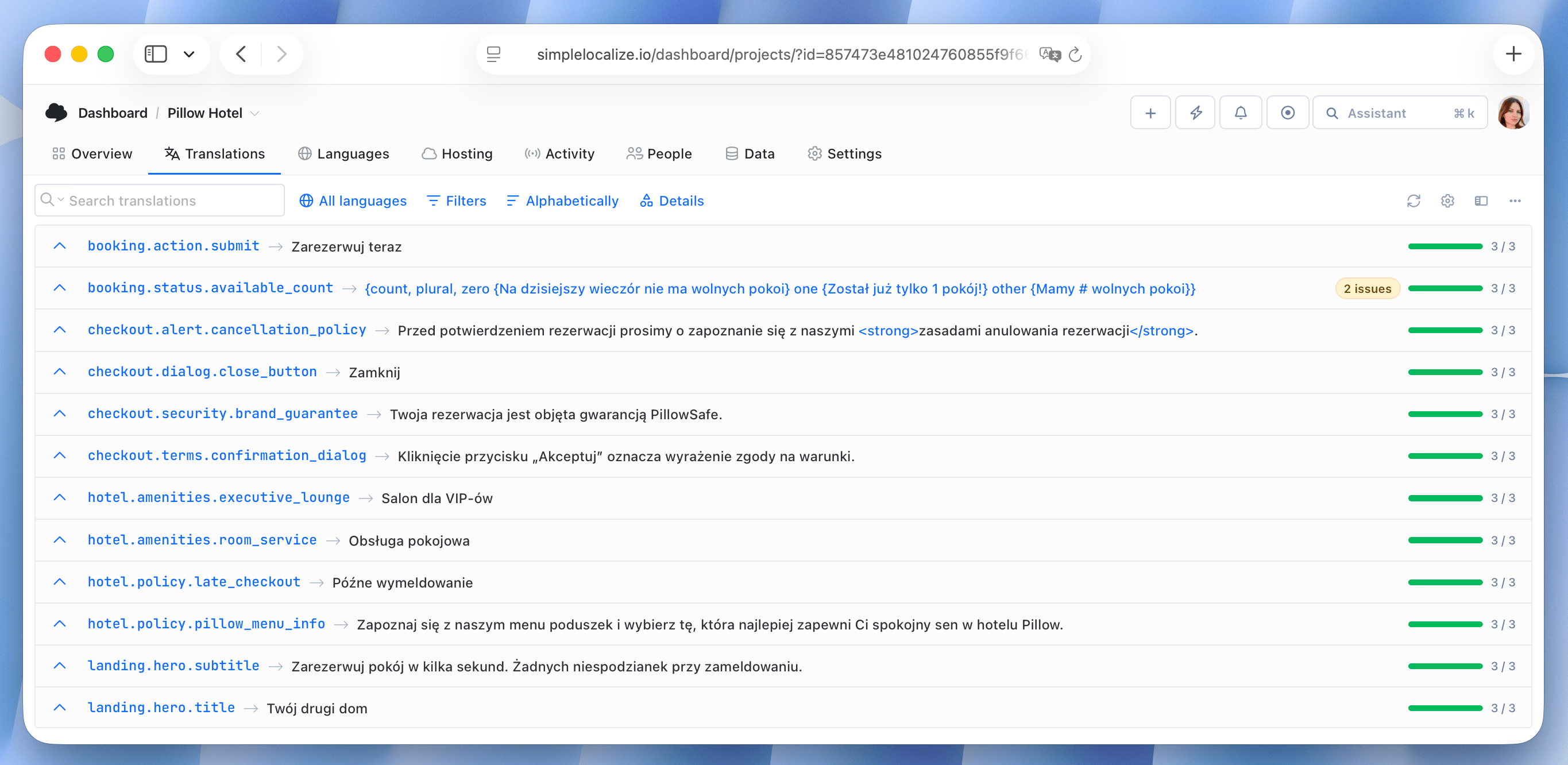
DeepL delivers beautiful phrasing, but its focus on raw sentence translation exposes classic NMT structural issues when context is omitted.
Observations:
- The Good: It localized
hotel.amenities.executive_loungecreatively to "Sala VIP" (ES) and "Salon dla VIP-ów" (PL). It also correctly inferred thatcheckout.dialog.close_buttonwas an active UI command ("Zamknij" / "Cerrar"). - The Bad: (The slavic plural trap): Look closely at the generated Polish plural:
{count, plural, zero {...} one {...} other {Mamy # wolnych pokoi}}. While syntactically valid, DeepL simply mapped the original keys. In Polish, numbers ending in 2, 3, or 4 require afewcategory ("Mamy # wolne pokoje"). Without it, your software's UI will display ungrammatical text.
SimpleLocalize's QA checks help catch these issues before they reach production. See how to set up QA checks for your translation workflow.
Google Translate
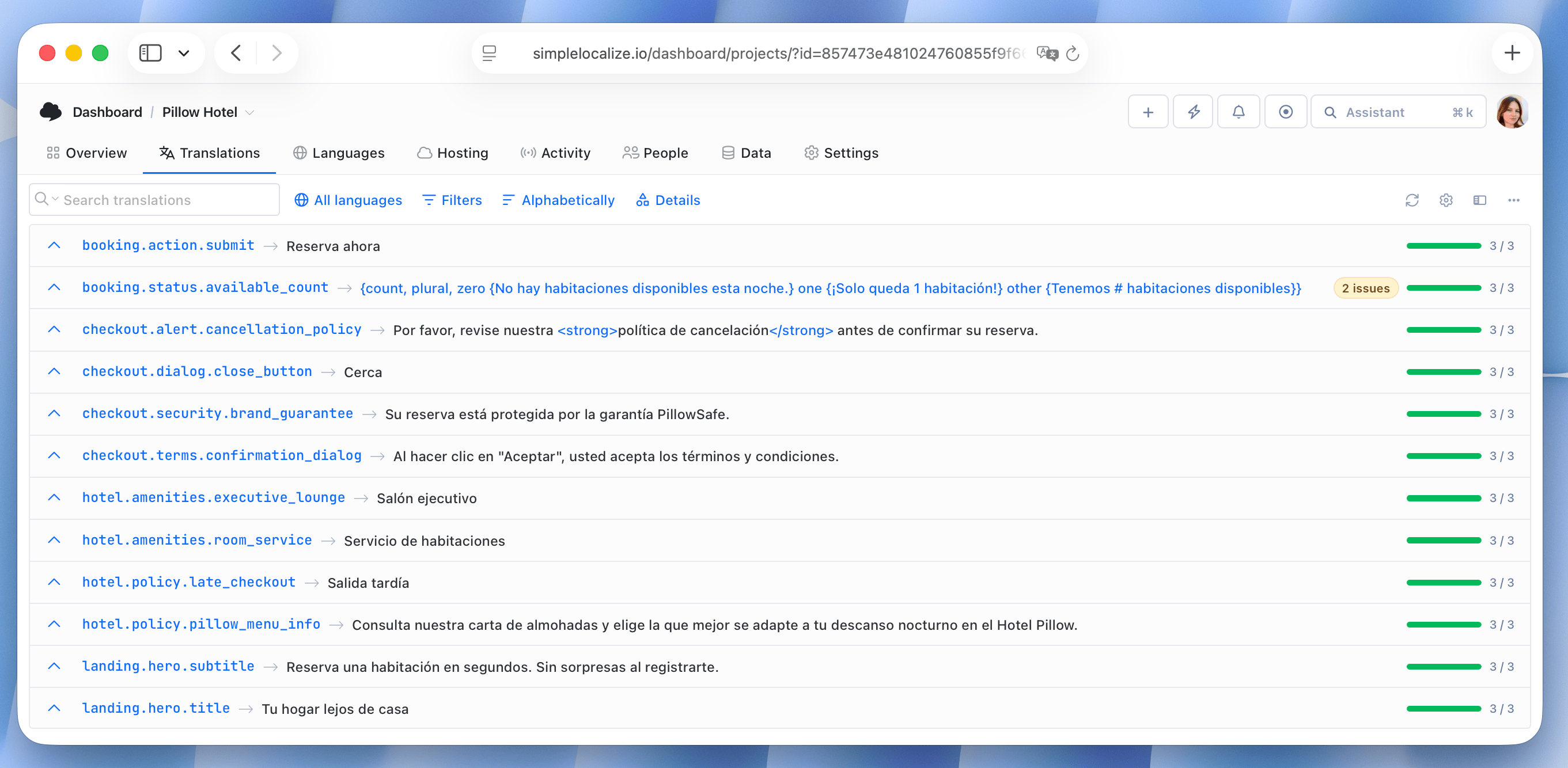
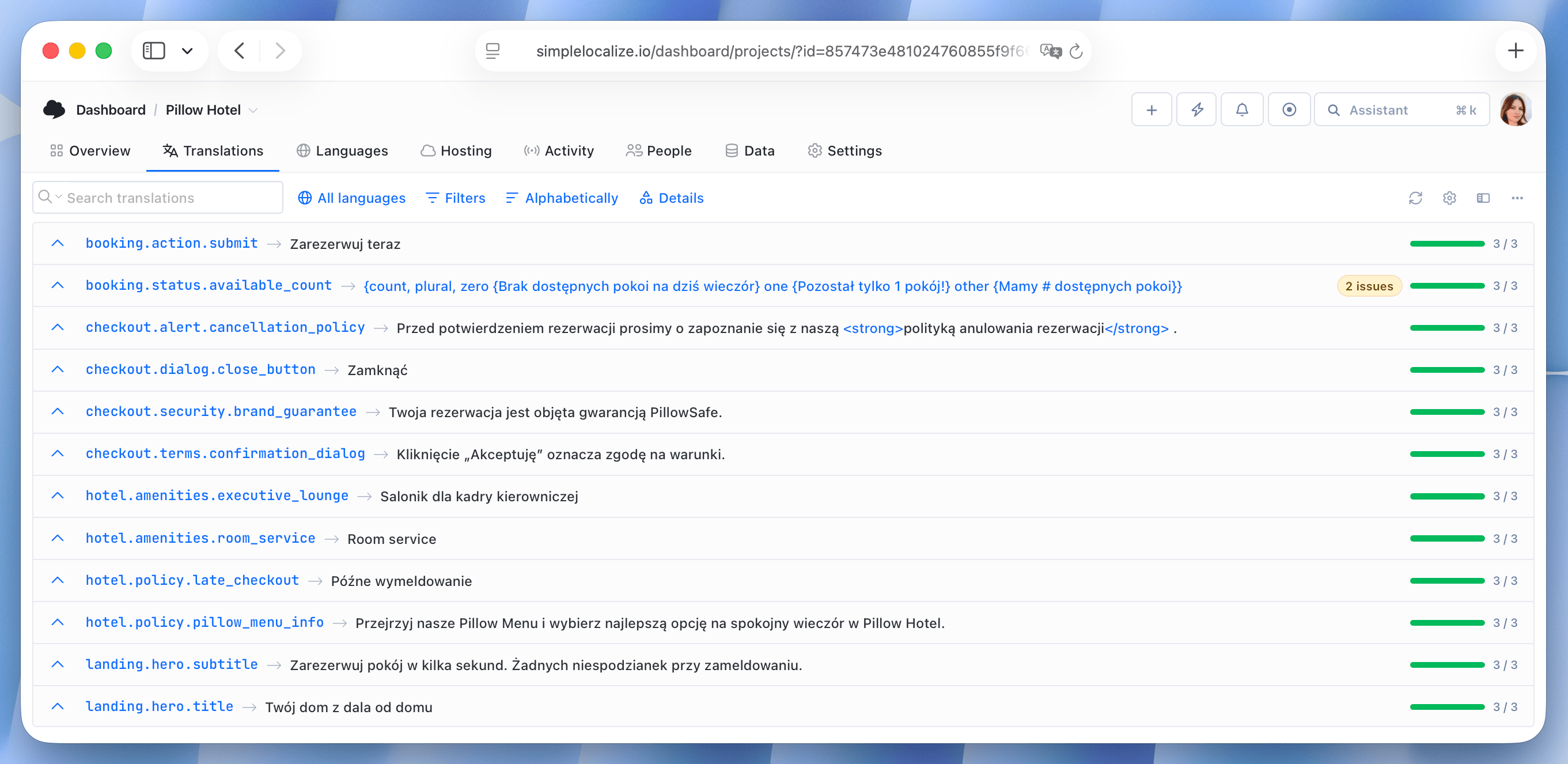
Google Translate covers immense ground but struggled the most with structural layout, app syntax, and context isolation:
Observations:
- UI button failure: For
checkout.dialog.close_button, it completely misfired, outputting "Cerca" (meaning near/close by in Spanish) and "Zamknąć" (the raw infinitive to close in Polish). - HTML & style vulnerability: In
checkout.alert.cancellation_policy, it appended an accidental trailing space before the punctuation:...<strong>polityką anulowania rezerwacji</strong> .. - Literal phrasing: It translated the premium lounge key into a literal "Salonik dla kadry kierowniczej" (Lounge for executive executives), which feels severely out of place in a hotel application.
OpenAI (GPT-4)
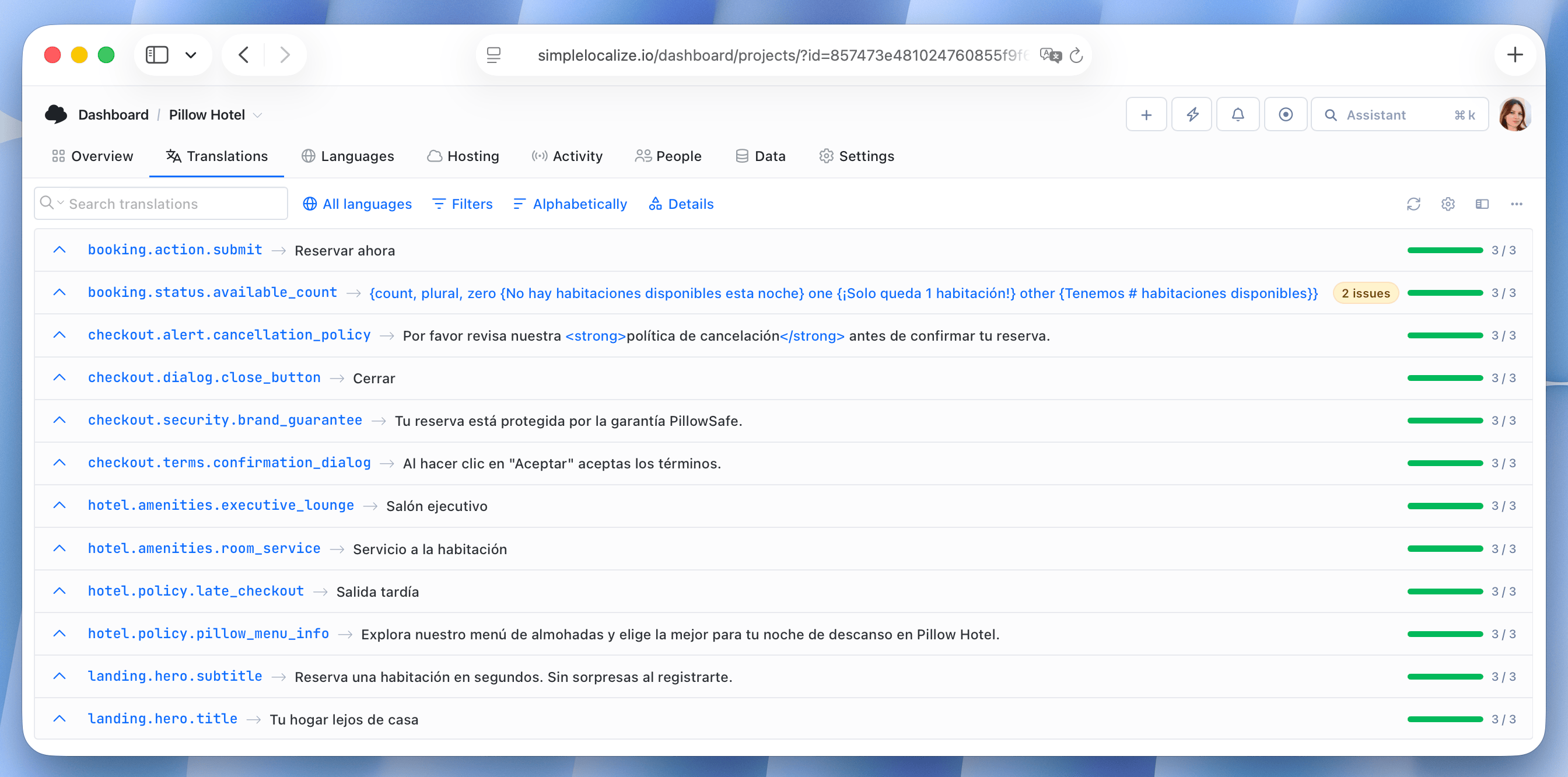
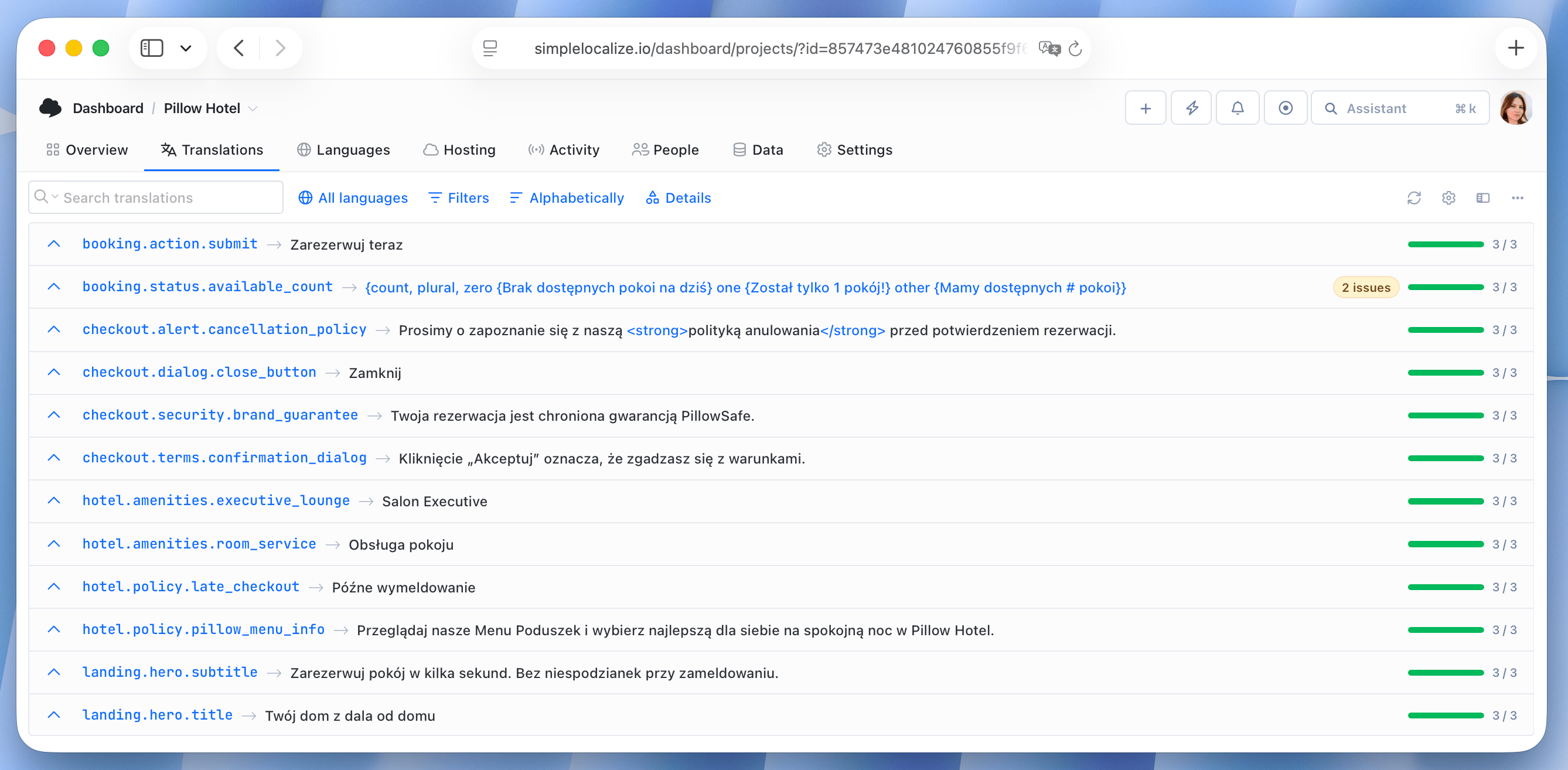
Running GPT-4 without any localization context instructions highlighted the natural engineering awareness inherent to LLMs:
Observations:
- Context guessing: Even without explicit instructions (no context provided), reading the string key
checkout.dialog.close_buttongave the model enough internal data to properly pick the operational verbs "Cerrar" and "Zamknij". - Clean code handling: HTML tags, variables, and escaped quotes ("„Akceptuj”") were kept structurally flawless with zero stray spacing or structural drift.
- The limit: Because it received no custom system prompts during this direct run, it preserved the input's original 1:1 ICU structure, copying over
zero,one, andotherwithout adding the Polishfewblock.
Anthropic Claude (Claude 4.5 Sonnet)
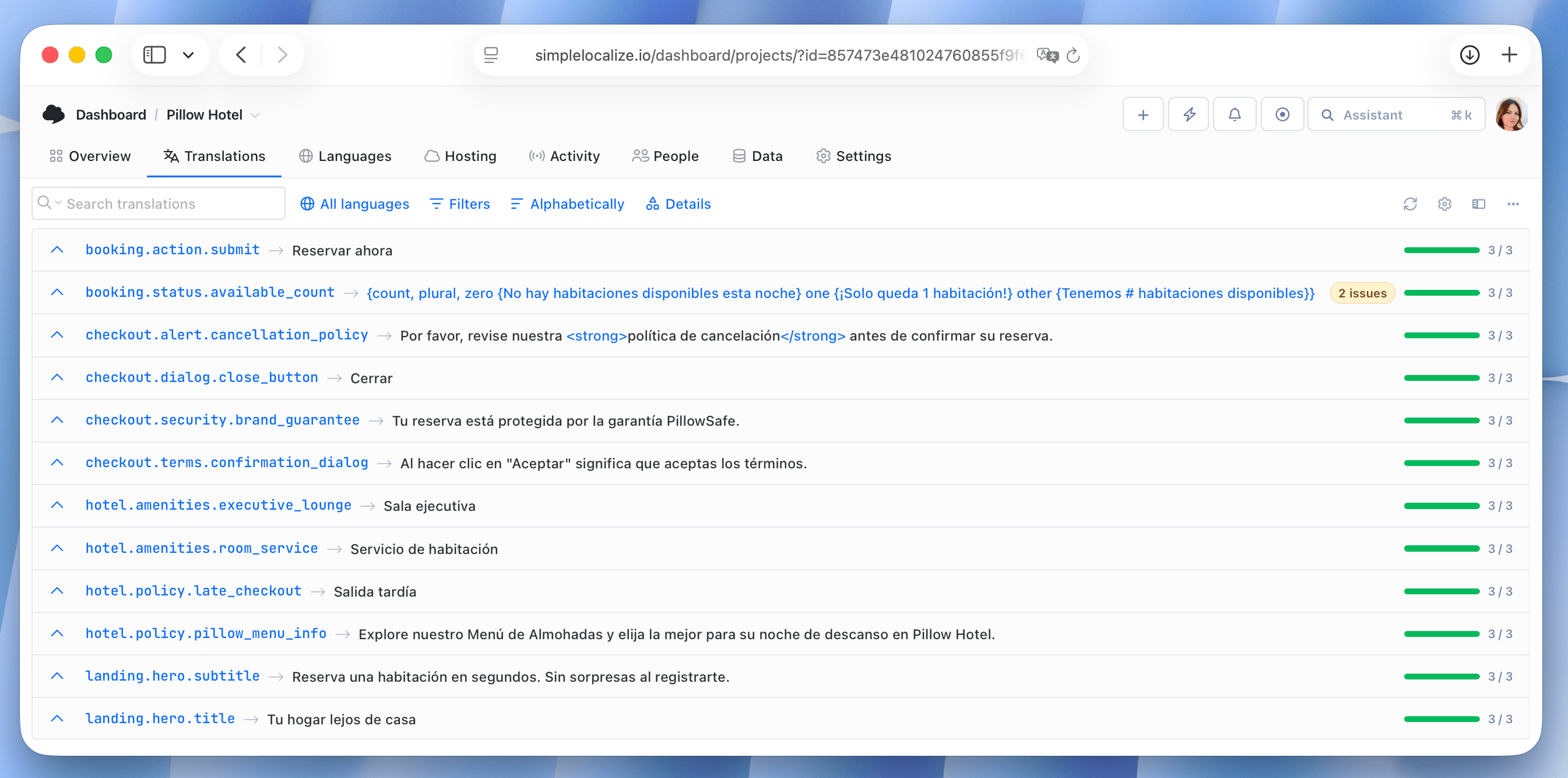
Claude 4.5 Sonnet focused heavily on matching premium brand semantics and linguistic rhythm:
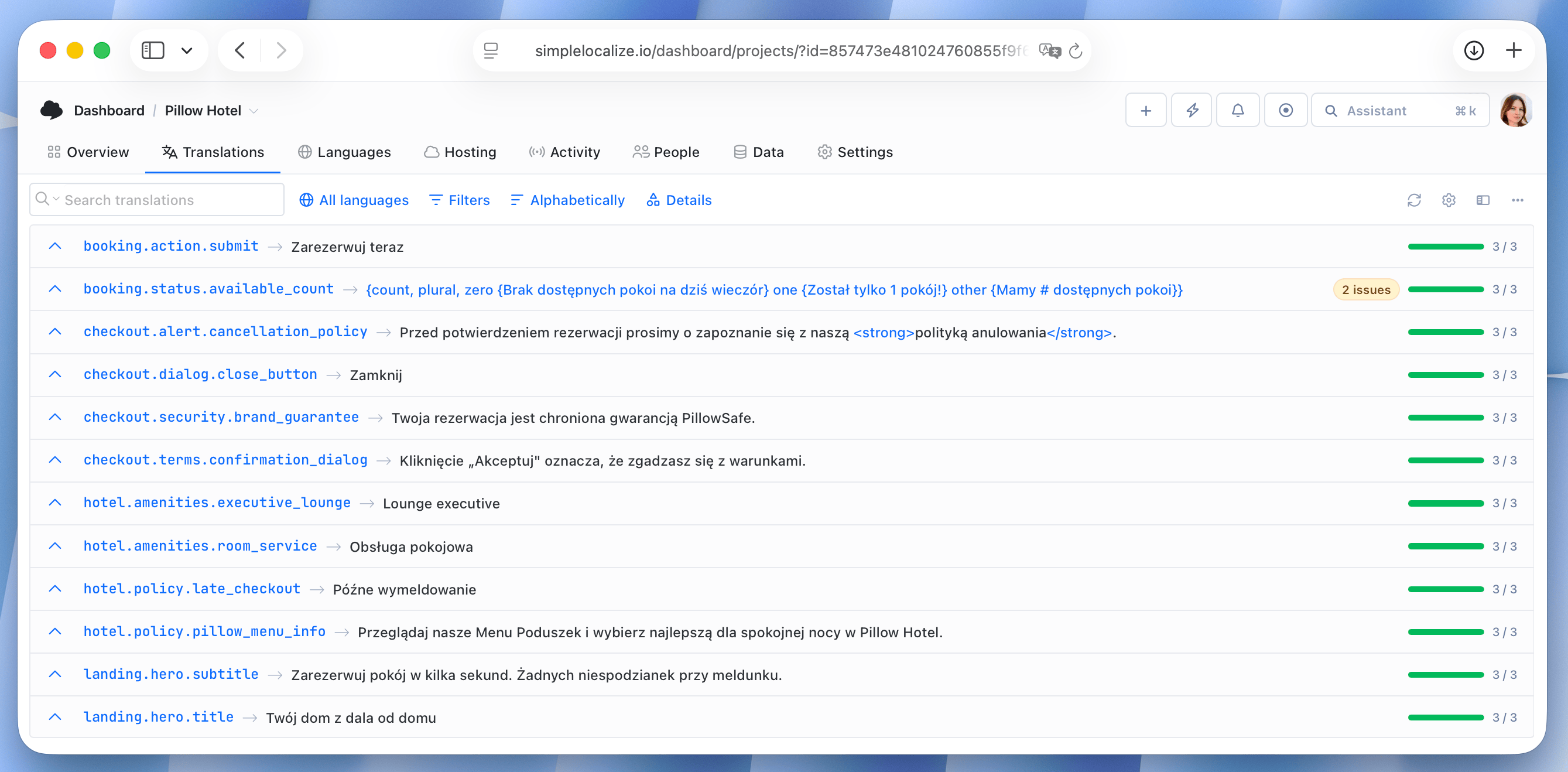
Observations:
- Linguistic elegance: It seamlessly adapted the text to "Lounge executive" (PL), striking a natural balance between English business travel terminology and local phrasing.
- Consistency: It retained the brand element "PillowSafe" across all languages while naturally adapting surrounding structures like Spanish inverted exclamation points ("¡Solo queda 1 habitación!").
Google Gemini (Gemini 2.5 Flash)
Gemini 2.5 Flash balanced speed with incredibly high literal software accuracy:

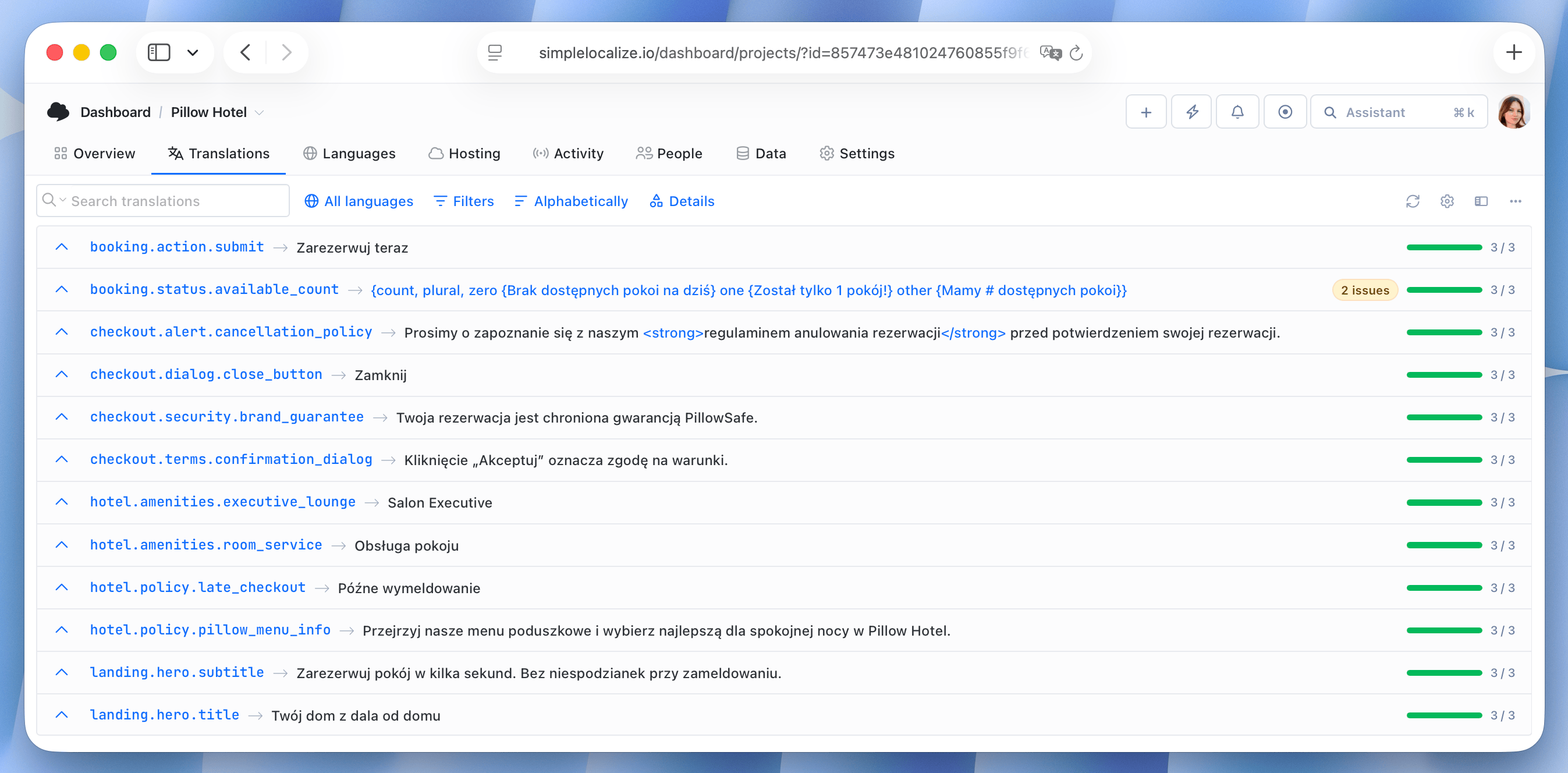
Observations:
- SaaS native phrasing: It chose "Salon Executive" for Polish and "Salón ejecutivo" for Spanish, making it highly appropriate for digital platform deployment.
- Clean layout: It managed nested markup tags smoothly, translating
checkout.alert.cancellation_policyinto fluid Polish: "...naszym regulaminem anulowania rezerwacji przed..." with perfect code token isolation.
Meta Llama (Llama 3.3 70B Instruct)
Llama 3.3 70B represents a major step forward for open-weights alternatives, though its high processing time reflects its deep computation path:
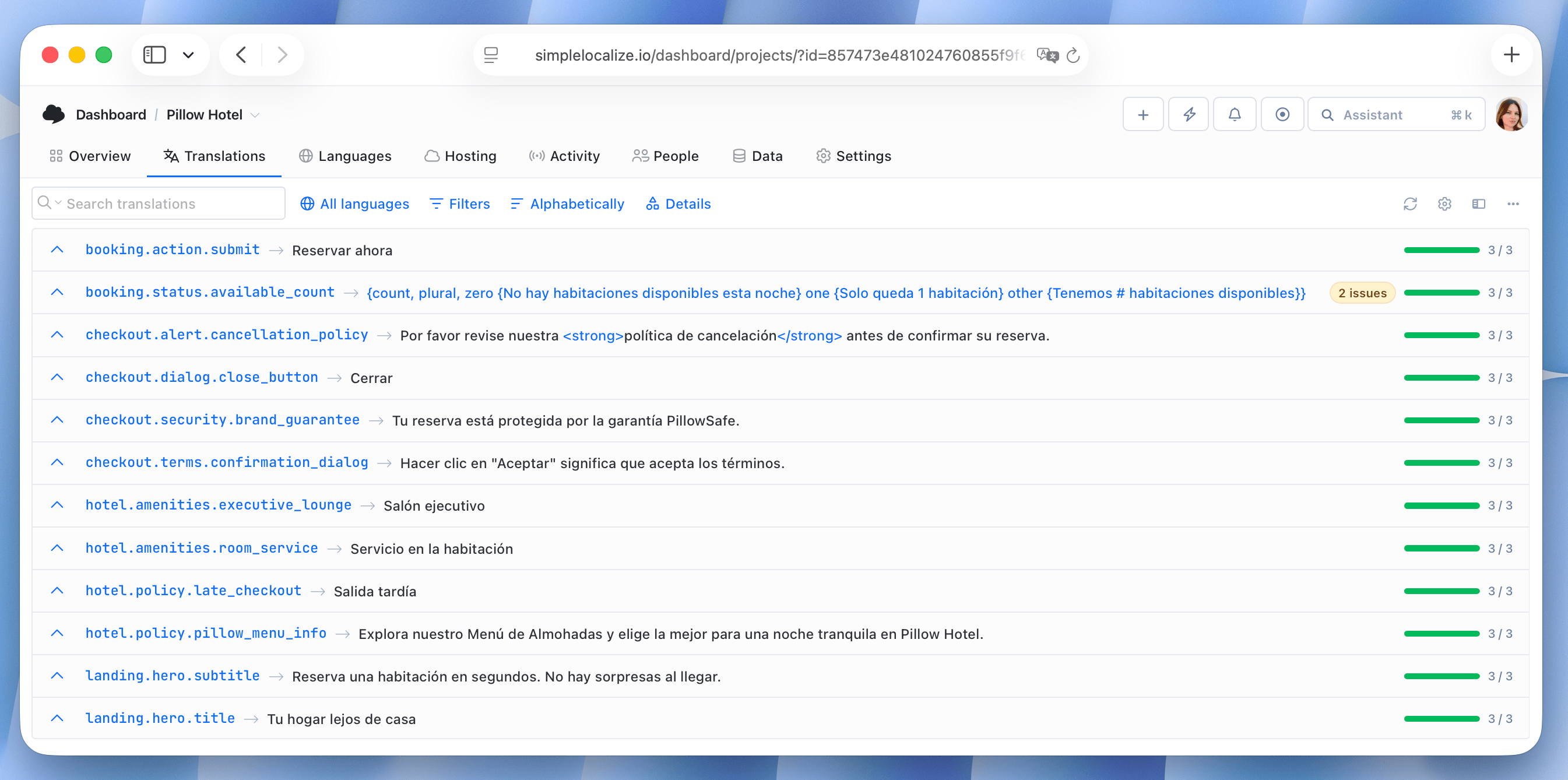
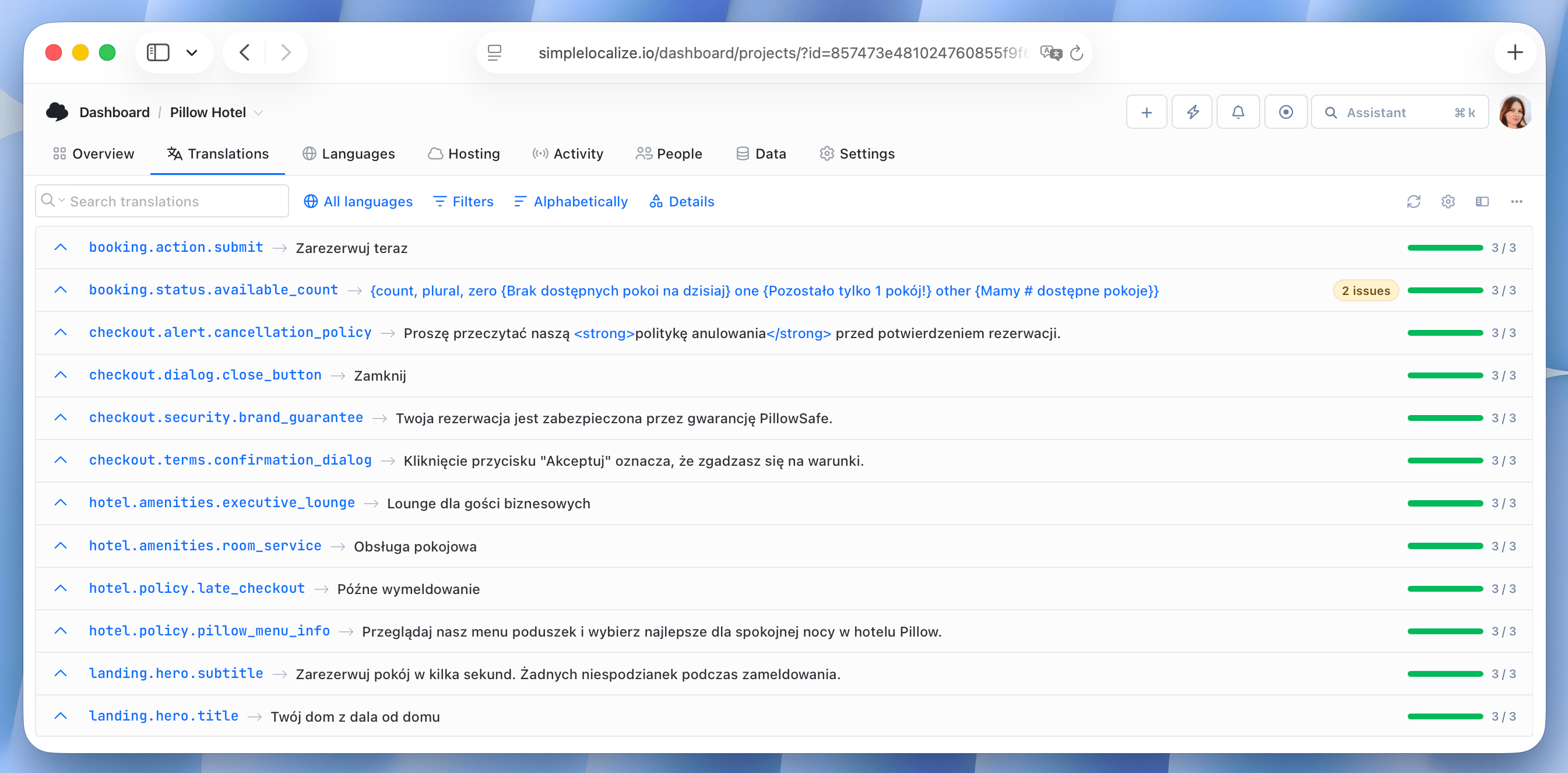
Observations:
- Verbose over-localization: For
hotel.amenities.executive_lounge, it gave a descriptive "Lounge dla gości biznesowych". This is highly accurate, though slightly wordy for tight user interface environments. - Grammar issues: It produced a few minor grammatical errors in Polish, such as "Przeglądaj nasz menu poduszek" instead of "Przeglądaj nasze menu poduszek".
Comparison
Below are side-by-side comparisons where rows are source texts and columns are translation providers.
English to Spanish
Translations to Spanish were generally accurate across all engines, with minor differences in tone and phrasing.
| Source text | DeepL | Google Translate | OpenAI (GPT-4) | Claude 4.5 Sonnet | Gemini 2.5 Flash | Llama 3.3 70B |
|---|---|---|---|---|---|---|
| Your home away from home | Tu hogar lejos de casa | Tu hogar lejos de casa | Tu hogar lejos de casa | Tu hogar lejos de casa | Tu segundo hogar | Tu hogar lejos de casa |
| Book a room in seconds. No surprises at check-in. | Reserva una habitación en unos segundos. Sin sorpresas al hacer el check-in. | Reserva una habitación en segundos. Sin sorpresas al registrarte. | Reserva una habitación en segundos. Sin sorpresas al registrarte. | Reserva una habitación en segundos. Sin sorpresas al registrarte. | Reserve una habitación en segundos. Sin sorpresas al registrase. | Reserva una habitación en segundos. No hay sorpresas al llegar. |
| Book now | Reserva ahora | Reserva ahora | Reservar ahora | Reservar ahora | Reservar ahora | Reservar ahora |
{count, plural, =0 {No rooms available tonight} one {Only 1 room left!} other {We have # rooms available}} | {count, plural, zero {Esta noche no hay habitaciones disponibles} one {¡Solo queda una habitación!} other {Tenemos # habitaciones disponibles}} | {count, plural, zero {No hay habitaciones disponibles esta noche.} one {¡Solo queda 1 habitación!} other {Tenemos # habitaciones disponibles}} | {count, plural, zero {No hay habitaciones disponibles esta noche} one {¡Solo queda 1 habitación!} other {Tenemos # habitaciones disponibles}} | {count, plural, zero {No hay habitaciones disponibles esta noche} one {¡Solo queda 1 habitación!} other {Tenemos # habitaciones disponibles}} | {count, plural, zero {No hay habitaciones disponibles esta noche} one {¡Solo queda 1 habitación!} other {Tenemos # habitaciones disponibles}} | {count, plural, zero {No hay habitaciones disponibles esta noche} one {Solo queda 1 habitación} other {Tenemos # habitaciones disponibles}} |
| Room service | Servicio de habitaciones | Servicio de habitaciones | Servicio a la habitación | Servicio de habitación | Servicio de habitaciones | Servicio en la habitación |
| Executive lounge | Sala VIP | Salón ejecutivo | Salón ejecutivo | Sala ejecutiva | Salón ejecutivo | Salón ejecutivo |
| Browse our Pillow Menu and choose the best one for your restful night at Pillow Hotel. | Echa un vistazo a nuestra carta de almohadas y elige la que mejor se adapte a tu noche de descanso en el Pillow Hotel. | Consulta nuestra carta de almohadas y elige la que mejor se adapte a tu descanso nocturno en el Hotel Pillow. | Explora nuestro menú de almohadas y elige la mejor para tu noche de descanso en Pillow Hotel. | Explore nuestro Menú de Almohadas y elija la mejor para su noche de descanso en Pillow Hotel. | Explore nuestro Menú de Almohadas y elija la mejor para su noche de descanso en Pillow Hotel. | Explora nuestro Menú de Almohadas y elige la mejor para una noche tranquila en Pillow Hotel. |
| Late check-out | Salida tardía | Salida tardía | Salida tardía | Salida tardía | Salida tardía | Salida tardía |
| Please review our cancellation policy before confirming your booking. | Por favor, consulta nuestra política de cancelación antes de confirmar tu reserva. | Por favor, revise nuestra política de cancelación antes de confirmar su reserva. | Por favor revisa nuestra política de cancelación antes de confirmar tu reserva. | Por favor, revise nuestra política de cancelación antes de confirmar su reserva. | Por favor, revise nuestra política de cancelación antes de confirmar su reserva. | Por favor revise nuestra política de cancelación antes de confirmar su reserva. |
| Close | Cerrar | Cerca | Cerrar | Cerrar | Cerrar | Cerrar |
| Your booking is protected by PillowSafe guarantee. | Tu reserva está protegida por la garantía PillowSafe. | Su reserva está protegida por la garantía PillowSafe. | Tu reserva está protegida por la garantía PillowSafe. | Tu reserva está protegida por la garantía PillowSafe. | Su reserva está protegida por la garantía PillowSafe. | Tu reserva está protegida por la garantía PillowSafe. |
| Clicking "Accept" means you agree to the terms. | Al hacer clic en «Aceptar», aceptas las condiciones. | Al hacer clic en "Aceptar", usted acepta los términos y condiciones. | Al hacer clic en "Aceptar" aceptas los términos. | Al hacer clic en "Aceptar" significa que aceptas los términos. | Al hacer clic en "Aceptar", usted acepta los términos. | Hacer clic en "Aceptar" significa que acepta los términos. |
Notes:
- Gemini produced an interesting variation for
landing.hero.titlewith "Tu segundo hogar" (Your second home), which is a more colloquial and warm phrasing than the literal "Tu hogar lejos de casa". - "Servicio a la habitación" is more commonly used in Latin America, while "Servicio de habitaciones" is more common in Spain. Adding language and region context to your translation workflow can help avoid these regional differences.
- "Sala VIP", "Salón ejecutivo", and "Sala ejecutiva" are all valid translations for "Executive lounge". The right translation depends on the context of your hotel and its branding.
English to Polish
| Source text | DeepL | Google Translate | OpenAI (GPT-4) | Claude 4.5 Sonnet | Gemini 2.5 Flash | Llama 3.3 70B |
|---|---|---|---|---|---|---|
| Your home away from home | Twój drugi dom | Twój dom z dala od domu | Twój dom z dala od domu | Twój dom z dala od domu | Twój dom z dala od domu | Twój dom z dala od domu |
| Book a room in seconds. No surprises at check-in. | Zarezerwuj pokój w kilka sekund. Żadnych niespodzianek przy zameldowaniu. | Zarezerwuj pokój w kilka sekund. Żadnych niespodzianek przy zameldowaniu. | Zarezerwuj pokój w kilka sekund. Bez niespodzianek przy zameldowaniu. | Zarezerwuj pokój w kilka sekund. Żadnych niespodzianek przy meldunku. | Zarezerwuj pokój w kilka sekund. Bez niespodzianek przy zameldowaniu. | Zarezerwuj pokój w kilka sekund. Żadnych niespodzianek podczas zameldowania. |
| Book now | Zarezerwuj teraz | Zarezerwuj teraz | Zarezerwuj teraz | Zarezerwuj teraz | Zarezerwuj teraz | Zarezerwuj teraz |
{count, plural, =0 {No rooms available tonight} one {Only 1 room left!} other {We have # rooms available}} | {count, plural, zero {Na dzisiejszy wieczór nie ma wolnych pokoi} one {Został już tylko 1 pokój!} other {Mamy # wolnych pokoi}} | {count, plural, zero {Brak dostępnych pokoi na dziś wieczór} one {Pozostał tylko 1 pokój!} other {Mamy # dostępnych pokoi}} | {count, plural, zero {Brak dostępnych pokoi na dziś} one {Został tylko 1 pokój!} other {Mamy dostępnych # pokoi}} | {count, plural, zero {Brak dostępnych pokoi na dziś wieczór} one {Został tylko 1 pokój!} other {Mamy # dostępnych pokoi}} | {count, plural, zero {Brak dostępnych pokoi na dziś} one {Został tylko 1 pokój!} other {Mamy # dostępnych pokoi}} | {count, plural, zero {Brak dostępnych pokoi na dzisiaj} one {Pozostało tylko 1 pokój!} other {Mamy # dostępne pokoje}} |
| Room service | Obsługa pokojowa | Room service | Obsługa pokoju | Obsługa pokojowa | Obsługa pokoju | Obsługa pokojowa |
| Executive lounge | Salon dla VIP-ów | Salonik dla kadry kierowniczej | Salon Executive | Lounge executive | Salon Executive | Lounge dla gości biznesowych |
| Browse our Pillow Menu and choose the best one for your restful night at Pillow Hotel. | Zapoznaj się z naszym menu poduszek i wybierz tę, która najlepiej zapewni Ci spokojny sen w hotelu Pillow. | Przejrzyj nasze Pillow Menu i wybierz najlepszą opcję na spokojny wieczór w Pillow Hotel. | Przeglądaj nasze Menu Poduszek i wybierz najlepszą dla siebie na spokojną noc w Pillow Hotel. | Przeglądaj nasze Menu Poduszek i wybierz najlepszą dla spokojnej nocy w Pillow Hotel. | Przejrzyj nasze menu poduszkowe i wybierz najlepszą dla spokojnej nocy w Pillow Hotel. | Przeglądaj nasz menu poduszek i wybierz najlepsze dla spokojnej nocy w hotelu Pillow. |
| Late check-out | Późne wymeldowanie | Późne wymeldowanie | Późne wymeldowanie | Późne wymeldowanie | Późne wymeldowanie | Późne wymeldowanie |
| Please review our cancellation policy before confirming your booking. | Przed potwierdzeniem rezerwacji prosimy o zapoznanie się z naszymi zasadami anulowania rezerwacji. | Przed potwierdzeniem rezerwacji prosimy o zapoznanie się z naszą polityką anulowania rezerwacji . | Prosimy o zapoznanie się z naszą polityką anulowania przed potwierdzeniem rezerwacji. | Przed potwierdzeniem rezerwacji prosimy o zapoznanie się z naszą polityką anulowania. | Prosimy o zapoznanie się z naszym regulaminem anulowania rezerwacji przed potwierdzeniem swojej rezerwacji. | Proszę przeczytać naszą politykę anulowania przed potwierdzeniem rezerwacji. |
| Close | Zamknij | Zamknąć | Zamknij | Zamknij | Zamknij | Zamknij |
| Your booking is protected by PillowSafe guarantee. | Twoja rezerwacja jest objęta gwarancją PillowSafe. | Twoja rezerwacja jest objęta gwarancją PillowSafe. | Twoja rezerwacja jest chroniona gwarancją PillowSafe. | Twoja rezerwacja jest chroniona gwarancją PillowSafe. | Twoja rezerwacja jest chroniona gwarancją PillowSafe. | Twoja rezerwacja jest zabezpieczona przez gwarancję PillowSafe. |
| Clicking "Accept" means you agree to the terms. | Kliknięcie przycisku „Akceptuj” oznacza wyrażenie zgody na warunki. | Kliknięcie „Akceptuję” oznacza zgodę na warunki. | Kliknięcie „Akceptuj” oznacza, że zgadzasz się z warunkami. | Kliknięcie „Akceptuj" oznacza, że zgadzasz się z warunkami. | Kliknięcie „Akceptuj” oznacza zgodę na warunki. | Kliknięcie przycisku "Akceptuj" oznacza, że zgadzasz się na warunki. |
Notes:
- Repeating "dom" and "domu" in Polish translations sounds a bit redundant, but it is grammatically correct. DeepL opted for "Twój drugi dom" (Your second home) to avoid repetition.
- "Executive lounge" has been translated in various ways, including "Salon dla VIP-ów", "Salonik dla kadry kierowniczej", and "Lounge executive". The choice of translation may depend on the target audience and the hotel's branding.
- Llama's translation of "Proszę przeczytać naszą politykę anulowania przed potwierdzeniem rezerwacji." sounds a bit rude in Polish, as it uses the imperative form "Proszę przeczytać" (Please read), which can come across as commanding. A softer phrasing would be more appropriate for customer-facing content.
Cost of translation
Pricing mechanisms differ drastically between character-based routing and token-based AI structures.
Characters vs. Tokens
DeepL and Google Translate charge flat rates per character. LLMs bill per token (split into input and output processing groups).
Cost comparison
Estimated cost to translate 1,000,000 source characters into one target language (rough equivalents):
| Provider / Model type | Pricing metric | Est. cost per 1M chars | Ideal scenario |
|---|---|---|---|
| DeepL API Growth | Per character | ~$32.50 (base plan) | Natural European-language output |
| Google Translate NMT | Per character | ~$20 | Broad multi-language scaling |
| GPT-4.1 | Per token | ~$2.50 equivalent | Context-aware, brand-sensitive copy |
| Claude Sonnet 4.5 | Per token | ~$4.50 equivalent | Brand-sensitive, nuance-heavy copy |
| Gemini 2.5 Flash | Per token | ~$0.70 equivalent | Fast, cost-efficient batch translation |
| Llama 3.3 70B | Per token | ~$0.11 equivalent | Budget-friendly, high-quality translation |
Calculation note: Token estimates assume ~250 input tokens + ~250 output tokens per 1,000 source characters (with batched system prompts amortized). Input costs are calculated as: (250K x price per 1M input). Output costs as: (250K x price per 1M output). Example: Llama 3.3 at $0.10/M input and $0.32/M output = (250K x $0.10/M) + (250K x $0.32/M) = ~$0.11 per 1M source characters.
For a full breakdown including more models, DeepSeek, and how to estimate costs at scale, see our dedicated guide on how much AI translation costs.
Conclusion
This real-world evaluation proves that traditional MT and modern LLMs serve fundamentally different workflows:
- Stick with DeepL or Google Translate if you are moving large volumes of flat prose (like long blog entries or documentation guides) where structural software code isolation isn't a priority.
- Switch to Large Language Models (GPT, Claude, Gemini, Llama) if your asset bundle contains complex UI elements, nested HTML markup, specific brand guidelines, or string parameters.
SimpleLocalize completely removes the platform lock-in. You can connect your own API keys, load custom providers and save on translation costs thanks to smart caching while maintaining full control over your localization workflow.